
Meet AkiDevRule and akiflow: A Rule Set and Agent Council for AI Coding
AkiDevRule is an open-source rule set for AI coding agents with the akiflow skill: an agent council split by role against context flood and self-approval.
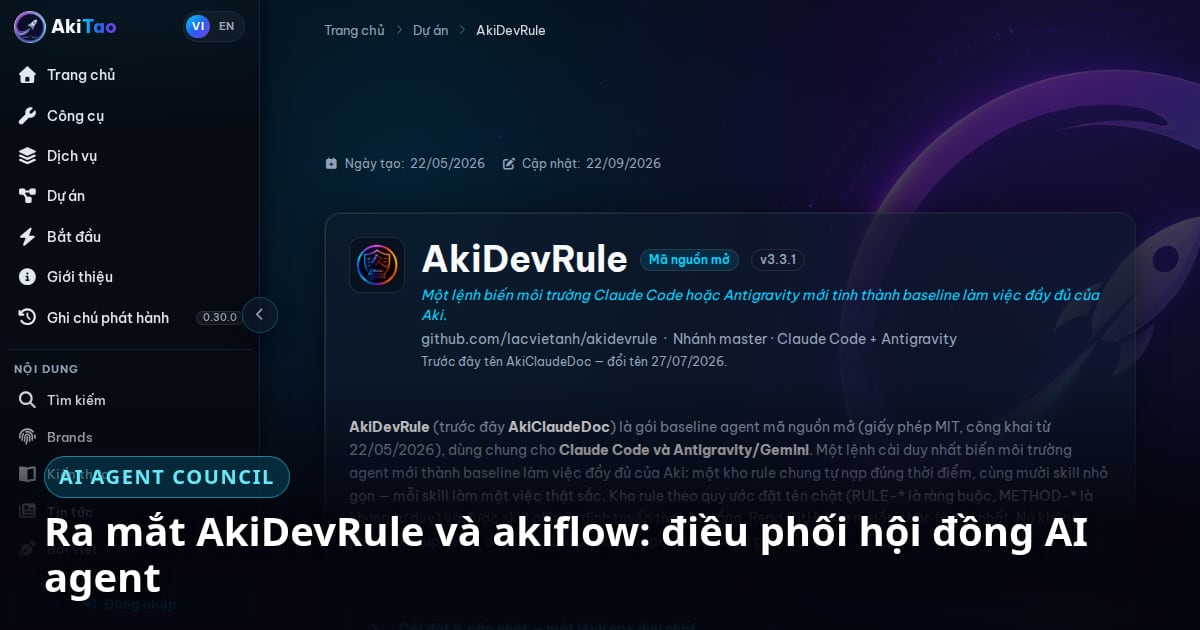
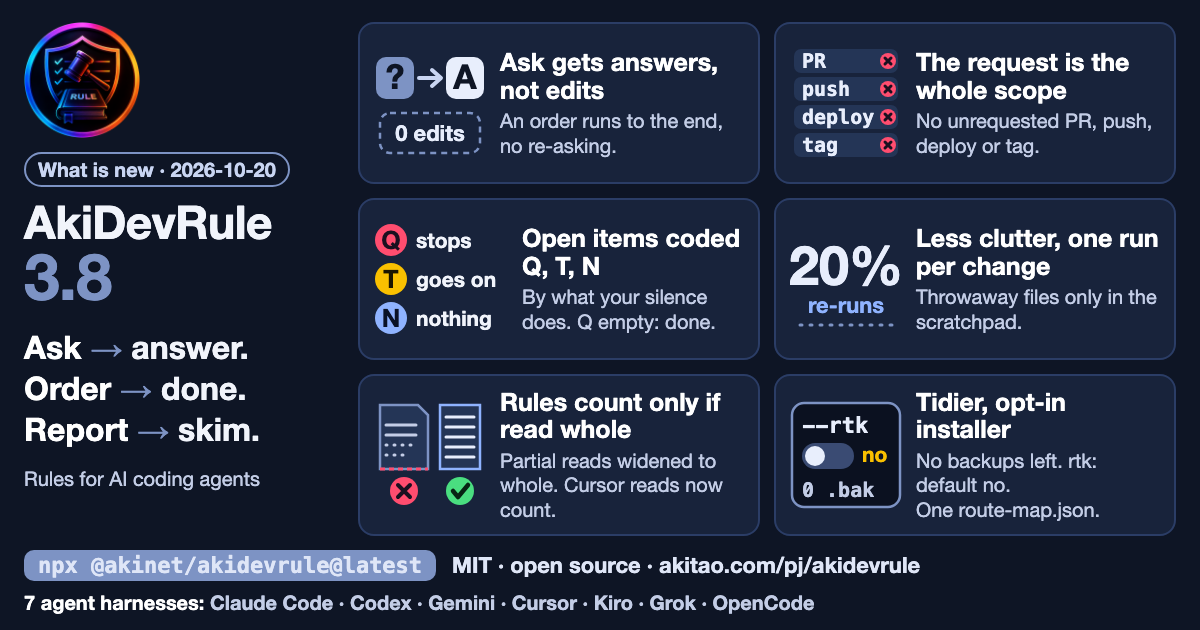
Updated 2026-10-21: this article records AkiDevRule as it stood when written. The latest release is 3.8.0 (2026-10-20); see the AkiDevRule project page and why an AI agent must not act when you only ask a question.
AkiDevRule is an open-source (MIT) rule set for AI coding agents such as Claude Code and Antigravity, shipped with ten skills, one of which is akiflow, which runs an agent council. The whole set targets three structural failures of an agent working alone: context flooding, role collapse, and self-approval.
A stronger model or a longer prompt does not fix these, because they come from structure: a context window has a limit, and the same context that produced a decision also grades it.
Why does a single AI agent working alone break down?
Context flooding: the request, codebase, plan, diff, and review all sit in one window. Each role added costs the earlier ones some accuracy.
Role collapse: one agent acts as architect, implementer, UX critic, and reviewer, so it applies a single standard of "correct" to problems that are judged by different standards.
[CAUTION] Self-approval: the context that produced a decision cannot judge it objectively. A reviewer that shares the author's context inherits the author's wrong assumptions too.
AkiDevRule: one source of truth, every rule addressable
The rule set has three tiers. The core tier is loaded into every session through @-imports in ~/.claude/CLAUDE.md: index.md, RULE-agent-behavior.md, RULE-coding.md, RULE-pattern-core.md, and the akirule routing skill. The contextual tier holds domain rules (RULE-docs.md, RULE-release.md, RULE-seo.md, RULE-ui-pattern.md, and others) that are read only when a task touches that domain. The analytical tier holds thinking and audit methods such as METHOD-deep-think.md, METHOD-audit-flow.md, and METHOD-ux-psych.md.
Every rule has an address in the form topic.A1. For example, coding.B3 says a change that needs an action against an external system is not done when the file is written, and agent.B5 makes every audit read-only. Agents cite a rule by address instead of paraphrasing it.
How does akiflow run an agent council?
You call /akiflow <request> and the session becomes the "lead". The lead follows two laws. R1 (Anchor): the owner's words are immutable and are the final test, so the lead may not reinterpret them. R2 (Justification): every mechanism, including seats, checks, and scripts, is off by default and turns on only when this run gives a reason.
Before opening a room, the lead pins the request verbatim, splits it into work items that each have an owner, a challenger, and a closing criterion, then checks a three-condition activation gate: decomposable into at least two items, more than one standard of "correct", and cost of error above cost of coordination. Details are in the activation gate article.
Two shapes, three modes: council when there is something to arbitrate, dispatch when the answer is knowable and the work is merely large (split into lanes with exclusive file ownership). Mode discuss changes nothing outside the room, audit is read-only, and only execute may edit files.
Five fixed agent definitions: aki-hands retrieves and may not judge; aki-judge judges against exactly one standard named at spawn; aki-conduct checks process, using scythe.py; aki-challenger attacks the result from a clean context; aki-maker is the only agent allowed to write files.
Gate scripts: council_open.py pins the owner's message verbatim and refuses to open a room without it, and --convene refuses to convene until at least one item has an owner, a challenger, and a closing criterion; council_read.py locates first and then reads only the needed part; council_verify.py blocks closure on a missing [RULES] receipt, a missing FACT/CONSTRAINT/ASSUMPTION tag, or a requirement no item covers; council_cost.py totals the tokens spent when the run closes.
In use across the Aki ecosystem
AkiDevRule is the shared rule set for projects in the Aki ecosystem, including Nuxt 4 and Cloudflare projects such as akitao.com (through RULE-stack-akiNuxtCf.md).
As of version 3.4.0 (2026-09-26), the set has ten skills: akiflow, akiship, akirule, akithink, akilint, akigitcommit, akihelp, akihtmlreport, akidevsync-notes, and aki-article-writer. /akiship folds the daily release ritual (lint, diff-scoped cleanup, doc sync, grouped commits, deciding whether to mint a version or defer it, building artifacts) into one command that follows release.B7 and release.B8 instead of restating them.
Installing AkiDevRule and akiflow
Run npx @akinet/akidevrule@latest (Node.js 18+ required). It installs self-loading rules for Claude Code and Antigravity and copies the skills to CLIs that use the SKILL.md standard, such as Codex CLI, Kiro CLI, and Grok CLI. Re-run the same command to update.
All source is public under the MIT license on GitHub (lacvietanh/akidevrule).